The Dangers of Identifying with Your Healing Journey
It is the nature of creative people to want to explore, experiment and experience more of life. We are more inclined to become invested in our ideas as we are more inclined to be invested in ideas of a deeper meaning in life. As deep feeling, sensitive or creative people, we can be drawn into the relief, soothing or freeing sensations different healing practices can bring us and the excitement, interest and perks we get from trying new things and indulging our imagination.
We can go from trying many things to being totally engrossed in certain practices as they become habits, crutches, or lose their helpful potency.
When we feel drawn to a holistic process, it includes many aspects of consideration or interest. When we begin to explore new ideas, such as energy or spirituality, when we realise the connected nature of life and how our mind and body can adapt and change in unexpected ways, it has benefits, of course. Still, it can also invite us into more and more uncharted territory.
The healing feels soothing. The recovery process gives us a sense of purpose, and these stages and phases of the process need to be embraced and enjoyed.
There is no set time for the stages of healing or a fixed path to pinpoint or draw a line clearly, but as we develop self-awareness and pay attention to what is happening for us in a life design process, being aware of keeping balance is helpful.
Ideally, we want to benefit, but not become dependent upon the healing modalities or the recovery journey.
And it may happen at times where we start to see that this has become the case, and we might have to assess our responses and behaviour if they have become compulsions or too limiting, restrictive or stifling in some way in our lives.
We can become addicted to the support we find in groups, in therapy or through codependent relationships. We can become reliant on the financial or social aid we received for being sick, healing or in recovery. We can become entangled in spiritual or religious ideologies so much that they feel like an obligation or begin to create anxiety as we create so many expectations around ourselves or others.
We can feel a dependence upon the process of healing and the energetic interest it brings, obsessed with the idea of getting better and better. Striving to reach unattainable imagined levels of human perfection or states of perpetual bliss that are not realistic. It's hedonistic in its nature, the desire to always be high, or relaxed, or happy, which is not based on the reality of a grounded, varied, fulfilled human experience.
What once was helpful, nurturing and supportive can become stifling, obsessive, dependent, and restrictive.
This type of deep healing journey can feed many aspects of the creative mind, bringing us the interest we crave. The danger is that we can be pulled into the journey so much so that it can take us away from practical work, for example, causing financial or housing problems. It can separate us from friends, socialising and public interaction as we take time to deeply introspect. It can attract us away from our family, leaving us isolated.
Issues like additional social anxiety, depression and developing fundamentalist beliefs or hateful intolerance can arise. It can leave us in an endless cycle of needing more and more healing and never finding peace or wellness or feeling enough as we are.
There is a time, place and phase for separation, isolation, active participation and experimentation as we heal. But there is also caution to be considered as we learn about ourselves and find the natural boundaries that aid the growth process and keep us well, but not controlled.
The journey, experimentation can become expensive and can cost us time, money, energy and our focus. The expense means we can become attached to the idea of outcomes from the journey. We see there is value in taking this time and doing healing work, particularly for creatives, especially introverts.
The healing of troublesome wounds and understanding our mind and personal expression can be how we forge our own path to security without past connections. It becomes vital to us for it to succeed when our reality becomes one of aloneness and self-sufficiency.
We might find that instead of allowing life to unfold, learning through experience, accepting where we are in the moment or the phase we are at, or the way things are occurring in a relationship, that we over-analyse, intellectualise everything and try to make sense of things that need to be experienced and accepted instead.
Creative people can often be adaptive, especially those who have experienced relational trauma and who are practised in codependent relationships. They can change and morph themselves into the type of person these modalities attract. Adopting the personality of the ideal client of these services in exchange for what we see as love, care or acceptance. The modality or even the healing journey itself can feel like a part of our identity and how we show up in the world.
We might start, for example, dressing a certain way because the teacher does, or adopting certain language that our therapist does or stopping certain activities we enjoy because our friends or peers in a group do. We take on the ideas of others and play with them. Which in itself isn’t a problem, being able to adapt and change is a skill at times. But it's when this is a role, a mask, a crutch, a facade or a phase that we can not outgrow, it becomes a problem for us.
In some cases, we can invest in it so much that we take it on as our calling, make it a career or change our entire lifestyle to suit the healing solution we most resonate with. This is fine, it has a part in society since it is how we pass knowledge to each other, but the problem comes when we are so attached to it we can't see beyond it, and now we are actually invested in the need for that healing modality it exist; for ourselves and others.
We might want to encourage other people to think they need the kind of healing we offer and position it as “the” answer to their problems (a form of manipulation). This is also where Western pathology and medical labelling get stuck. By labelling and requiring people to need the service we offer, we energetically require people to need healing. It is the epitome of the placebo effect. Because we believe we are [insert diagnosis or modality here], we become that. Or because we believe this worked for us, it must work for everyone. Especially when we identify with it, benefit from that identity point and need it to survive (financially or socially).
If this is something we are stuck on, or it actually limits us and our evolution, keeping us addicted or reliant upon it, as well as others, potentially. It keeps us in a place of requiring more and more healing. It ignores the reality that people change, move on and can heal. It ignores the laws of nature by creating a need within us that can not be filled by the practice itself anymore, but endlessly perpetuates.
Even if a healing journey is part of our lives, important to our growth and necessary for us, devoting our entire lives to seeking healing only attracts more to heal from.
Ultimately, healers, therapists or people on a healing journey, to have a modality be successful, it really needs to want (have the desire) to run out of clients/patients or for the cause (intial need) for the modality to be required, to be resolved; we need to be able to walk away when it does not serve us or has done its job.
This means our investments of time, energy, skill or education, even, need to always be considered as we grow.
To solve this cycle, we can look at ourselves, our behaviour and the practices we have tried, with consideration and discernment. Become the gardeners of our experience and, with wisdom, learn what to feed and what to prune. It requires bravery and a perspective of distance, consideration and logical reasoning, as well as an honest dive into the feeling and psyche behind what is being created by it all. A willingness to move, change, be wrong and to be or have something be surplus to requirements.
The solution I have found is to naturally allow things I don't resonate with to fall away. When I begin to notice resistance or a feeling of obligation arises around a practice or modality, I use self-inquiry to evaluate why I am doing what I am doing and define the source of the drive to do it.
I also make time to consider, reflect upon what I am practising, offering or investing in and regularly let go or amend what no longer serves me, my healing or my purpose. It is part of my life design process. If I don't do this, I have found life, the universe or fate (however you might refer to it) will intervene and remove what is not helpful or necessary from my life, regardless and often in a much more shocking or jarring way.
We know if something isn't right anymore when we begin to feel doubt, resistance and confusion around it.
We know when we are accepting ourselves when we are not fighting, explaining or justifying in our mind why we should or shouldn't do something.
We know we have understood our nature when we can allow ourselves the flexibility to come and go without the fear of judgment or loss dictating where we stay.
Considering where we might feel confused or anxious in our healing journey, when we feel stuck, unsuccessful, frustrated or disappointed in life, can be mended through taking the time to reflect on what does and what doesn't help. Asking what has been supportive to you and why, analysing when it became obsolete, accepting that reality and being open to change and moving on. This can be the secret ingredient to feeling more confident and expressive in your life.
At times, we may simply need to take a break; we might need time away from the practice to assess if it is still helpful. We might naturally be drawn toward something new or away from a particular place or person that offers a service. We might also have to consider if our resistance is due to our ego being defiant because something is working, challenging us and helping us to grow.
Being open to responding to what is presently relevant is where we can feel and live more authentically aligned to our innate creative nature. Feel the freedom and wellness that we have always longed for. We can do this alone or with the support of someone objective who is not attached to their own healing modality.
As we grow and pay attention to these patterns and cycles of healing, we also develop the discernment to know when the analysis can end, when the practice is mastered, and when what we have learned can simply be integrated into our lives without the need for it to be a constant or stay beyond its requirement.
Additional Support
If you found this blog interesting and helpful, you might also enjoy the following content:
In this video, I explain the Empathy and Validation Trap as we enjoy but get stuck in the idea or identity of our unwellness.
In this video, I am exploring Does Learning Matter? as we expand our knowledge and learn how to change our mind, start afresh, so we can grow and release ideas that keep us stuck.
You might also benefit from browsing the blogs in our Identity & Personal Growth category.
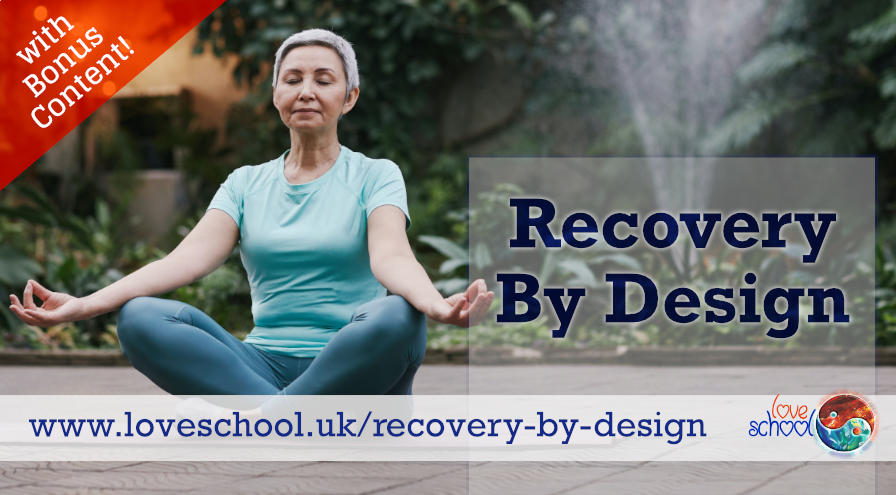
We explore how to use life design as you evolve through your recovery in our Natural Holistic Recovery Course. For the best value, I recommend our Recovery by Design Bundle that includes all our life design and recovery-based courses and content.
For personalised support, in our Mama Bear Mentorship programme, releasing confusion around your healing journey is one of the main things I help creative people recovering from trauma, addiction or ill health to figure out to go from anxious and disappointed to free and expressive.
We also work on clarifying boundaries and creating a life design. If you want to know more about this six-month programme, follow the link below to read more and apply.
Read about how Love School Started & How to make the most of the space here
Introducing Love School
Love School began with real experience and, after years of experimenting, research, and personal understanding of healing and recovery through natural, holistic methods.
Read our dedicated blog posts explaining what the space is about, why it was created and how you might use it to support your own healing or recovery journey.
Love School Pathways
What is Possible In Natural Recovery?
Love School Origin Story
Join Our blog Mailing List!
Share your details here to have our blog posts delivered to your inbox for free!
Looking to Explore More...
Blog Categories
Browse More of our blog Posts!
We cover a holistic range of blog categories to support the different stages of your healing or recovery journey.
As part of an ecosystem mindset, we offer insights into the interconnected areas to consider to create a balanced lifestyle.
Browse through our other blog categories below:
Browse Love School Shop!
Explore Love School Courses, Membership & support Services